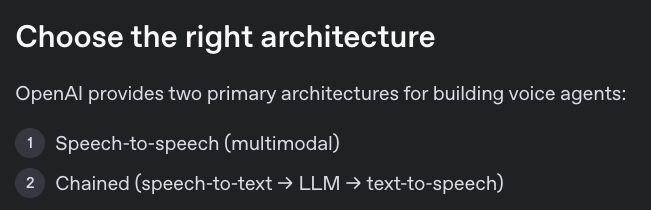
Before OpenAI launched their Realtime Voice API, critics claimed that Sindarin's cascaded approac...
Before OpenAI launched their Realtime Voice API, critics claimed that Sindarin's cascaded approach to speech would be rendered obsolete by end-to-end models like GPT-4o.
Yet, the Realtime Voice API was their first and only speech offering, which was followed by the introduction of a cascaded approach. This raises a critical question: why did OpenAI revert to an architecture deemed outdated by some?
To dissect this, we must scrutinize the underlying assumptions of the original claim. The assertion that cascaded models are inferior relies on the belief that end-to-end systems are universally superior. However, this overlooks the nuances of different use cases and the specific strengths of each architecture.
Moreover, the evidence presented often conflates correlation with causation. Just because one model was launched after another does not imply that the latter is a failure or that the former is the only viable option. Confirmation bias may also play a role in how we interpret these developments, selectively highlighting successes while downplaying limitations.
Key terms like 'obsolete' require precise definitions to avoid ambiguity. What does 'obsolete' truly mean in the context of voice AI? Are we discussing performance, usability, or market relevance?
This situation invites further exploration. What evidence can we gather to either support or challenge this analysis? Are there blind spots in our understanding of why OpenAI made this strategic choice?
Engaging in this discussion could lead to a more refined understanding of the evolving landscape of voice AI and the architectural choices that shape it.